For as long as there have been queens in France, there has never been a female monarch. No daughters of the King, the princesses of royal blood, have succeeded to the French crown and ruled in their own right.
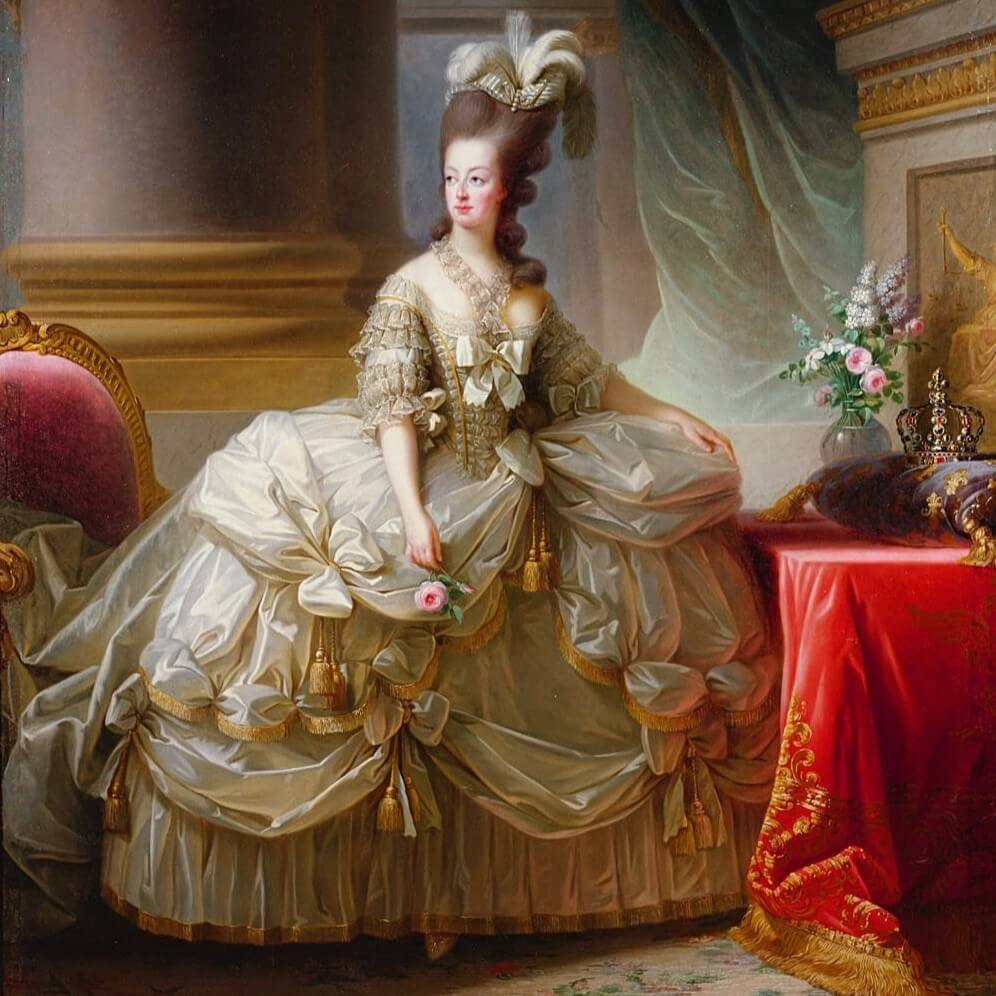
But wait, you say, what about Marie Antoinette? Wasn’t she a French queen?
Yes, but she was a Queen consort. Most French kings had wives, whose sole duty really was to produce an heir (and a spare if they were lucky).
In many European kingdoms, women could inherit power on the same terms as men. This was the case in England, the kingdom of Navarre, the kingdom of Naples, Hungary, Poland, and in Scandinavian countries. Isabella I, Queen of Castille, and Ferdinand of Aragon governed Spain together from 1479-1504.
So why not France?
Salic law
Many people would respond to that question with ‘because of Salic Law’. Salic Law, or la loi salique is a legal code from the sixth and seventh centuries in which laws regarding property and penalties were compiled for the first time as a written code. It is called Salic Law because many of the laws referred to the Salian Franks, a territory in what is today largely northern France, the Netherlands and Belgium. King Clovis, who is believed to have begun compiling the Salic Laws, was the first to unite all the Frankish tribes and is considered the first king of France.
But the problem is that Salic Law as it related to the French throne is a myth, a lie, nothing but a forged note on a medieval parchment which was used to deny women the right to rule.
the succession crisis
In France, for almost a thousand years, there were enough sons to inherit the throne from their fathers, so the rights of succession were never in question.
But in the twelfth century there was a moment, a tiny moment, when there could have been a true female monarch, ruling as the rightful heir to the throne. So what happened?
Philippe IV died in 1314, leaving three sons. Louis X, or Louis the Stubborn, was now on the throne. However, his reign was cut short after only two years when on a sunny June day he thirstily drank an entire flagon of iced wine following a game of tennis, and died shortly afterwards. Unfortunately for the monarchy, Louis X did not have any sons.
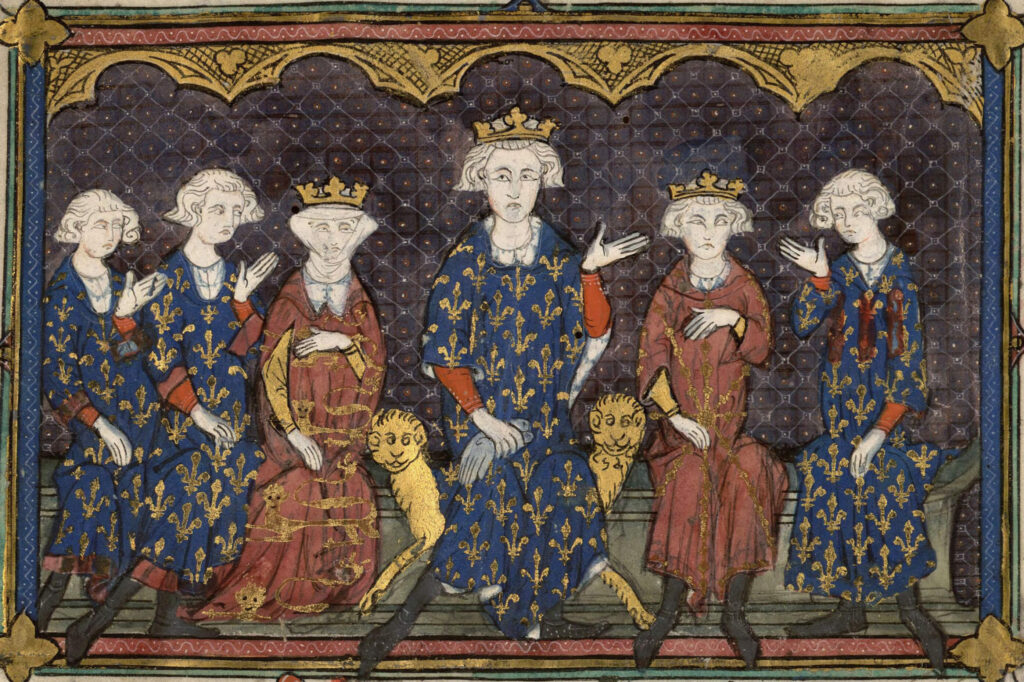
He had a daughter, Jeanne of France, four years old, whose paternity was somewhat in question. Her mother, Louis’ first wife, Margaret had been imprisoned in the Château de Gaillard several years before, suspected of adultery. Louis X also left behind a pregnant second wife, Clemence of Hungary.
By all rights, Jeanne of France should have been proclaimed ruler. And she almost was, as there was support amongst the nobles for her ascension to the throne. But Louis’ brother, Philippe, saw his opportunity. He persuaded the nobles that if the as yet unborn baby of Clemence was a boy, he would act as regent until the young king came of age. If it was a girl, Philippe would then become regent for his niece Jeanne until she turned 12, after which she would renounce her rights to the succession. So in effect, he was validating the claim of a female to the French throne.
Within a few months the baby was born, and it was a boy, the heir to the throne. The jubilation did not last very long, however, as he died after only 5 days (thus becoming John I the Posthumous).
The wily Philippe proclaimed the death of the heir had not been anticipated and therefore any previous understandings were null and void; he had himself crowned as king, Philip V. Jeanne was eventually given the kingdom of Navarre, where she was actually allowed to rule.
Interestingly, there was no mention of Salic Law at this time.
Philip V, also known as Philip the Tall, died in 1322. Ironically, he had only daughters, but their right to the throne was not even considered. The crown passed to his brother, Charles IV.
When Charles IV passed on shortly afterwards, in 1328, it led to another crisis of succession. This time, there were no sons and no brothers to inherit the throne.
However, there was a sister.
Isabella of France was the sister of Philip V and Charles IV, and the wife of Edward II, King of England. She claimed the French crown belonged to her son, Edward III, who was a direct grandson of Philip IV. However, the nobles declared that women could not pass on a right to rule they did not have, citing the two previous coronations. They declared the new king to be Philip of Valois, a first cousin and therefore the next indirect male heir, who was crowned Philip VI.
Again, the contemporary records of these events make no mention whatsoever of Salic Law.
a convenient discovery
Salic Law was ‘rediscovered’ in 1358 by a monk in the library of the Monastery of Saint-Denis. In the 1400s, some writers and prominent Parisians asserted that these ancient laws juridically established the exclusion of women from rule in the kingdom of France.
This is far from the truth.
The original laws did not contain any ordinance regulating succession to realm and rule, for males or females. There was a section which stated “Indeed concerning Salic land no part of the inheritance may pass to a woman, but all the inheritance of land goes to the virile sex”, but this was rewritten many years after the Franks, and contradicted other laws. Taken as a whole, Salic laws permitted women to inherit allodial lands (essentially family farms), sometimes favoured transmission through female lines, and also allowed other lands held in grant from rulers to pass (in the absence of males) to females.
And in the 1400s, French customary laws ensured that women succeeded to lands when there were no sons. There had been many wealthy medieval heiresses.
So how was the Salic Law used (falsely) to keep women off the throne?
no part in the realm may pass to a woman
From 1337 to 1453, the French and English fought each other in the Hundred Years’ War. On the French side were the Valois dynasty, with Charles VI as king. The English also claimed they had the right to the French throne, as descendants of their king Edward III, son of Isabella of France.

In 1413, diplomat and secretary to Charles V, Jean de Montreuil, wrote a treatise supporting the claims of the French Valois monarchy. In this work, called A toute la chevalerie, he cited a clause from the chapter on land inheritance and added the phrase: “Indeed no part in the realm may pass to a woman”. This was an absolute forgery on Montreuil’s part, as there was no mention of any realm in the original Salic texts.
At this time, the king Charles VI the Mad, was, well, mad. His queen, Isabeau of Bavaria, acted as regent each time her husband had an episode of insanity which could last for months. In 1402, Isabeau’s powers were extended to act in place of the king when he was unfit to do so. It was confirmed she held “power, authority and special instruction to appease all debates, discords, dissensions and divisions” that existed now or erupted in the future. This level of power was unprecedented for a queen consort.

The civil war engendered by Charles VI’s uncles and brothers who all wanted the regency for themselves was vicious. And so a debate over the capability of women to hold public office was welcomed by many men of the time. This also raises the question of how far the Salic Law was originally developed because of the misogynistic attitudes of fifteenth-century writers.
Banished from the throne forever
This loi Salique, première loi des Français, became the meansby which women and their descendants were officially excluded from inheriting the French crown.
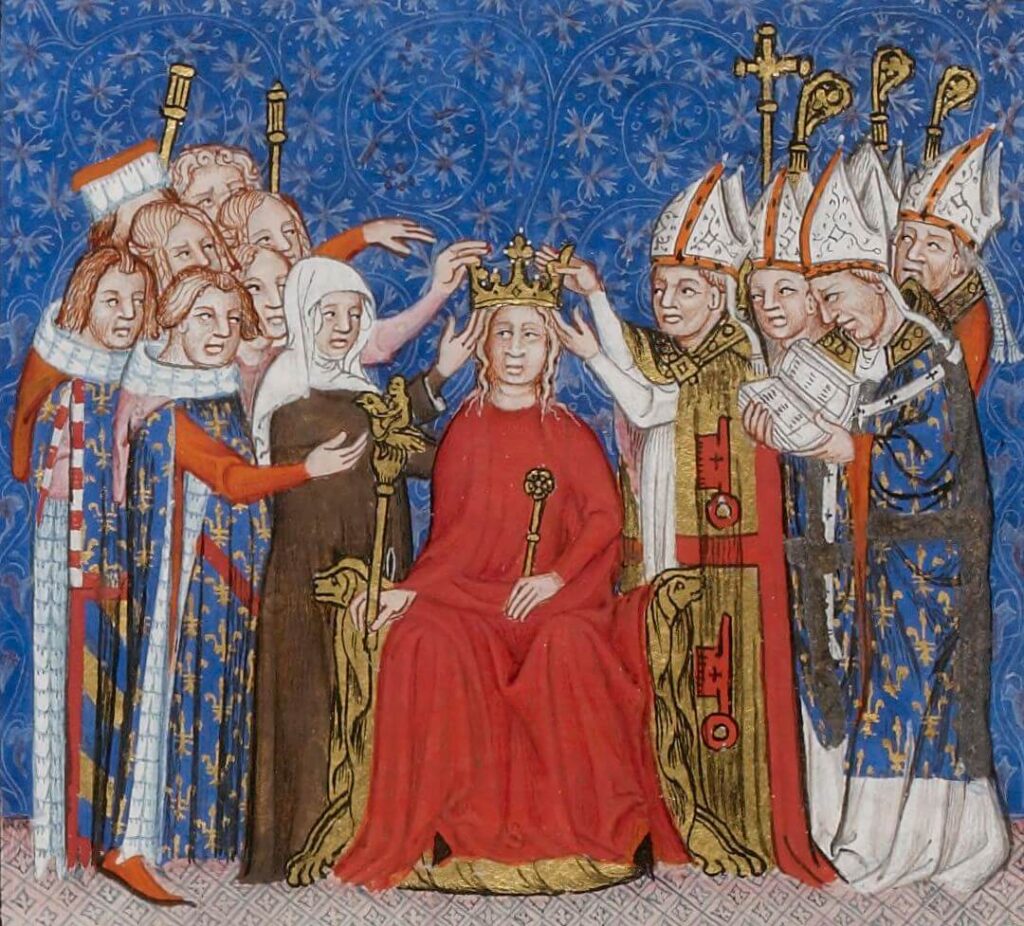
Both kings and queens were crowned in an elaborate coronation ceremony. That for the queen was quite different from that of her husband, in part to underline the fact that she could not hold power in her own right. Nevertheless, the coronation honours did accept that the wife of the king would exercise some political functions: she was granted the right to pardon criminals as an extension of the royal dignity held by kings; she also received a sceptre, a rod, and a ring, symbolizing her duty to be just and to combat heresy.
Aristotle really didn’t like women
Greek philosopher Aristotle had much to say on the natural weakness of women, and his ideas were also ‘rediscovered’ in the twelfth and thirteenth centuries. Aristotle believed women were born with a weaker body and little wisdom; while men were naturally the opposite with a strong physique and a developed intellect. According to the bible, women had been born of Adam to be his companion and to bear his children. Eve had given in to temptation when she took the apple in the Garden of Eden, and therefore all women were never to be trusted with matters of importance as they were too easily tempted. They must remain subjugated. A twelfth-century abbot warned men that a woman’s anger makes females “poisonous animals … [T]he poison of asps and dragons is more curable and less dangerous to men than the familiarity of women.” A popular and common theme for church sermons was the sins of females – they were liars, temptresses, gossips, lustful, proud and backstabbing. A proverb of the time stated: “Woman is an evil that man cannot avoid”.

Regent queens
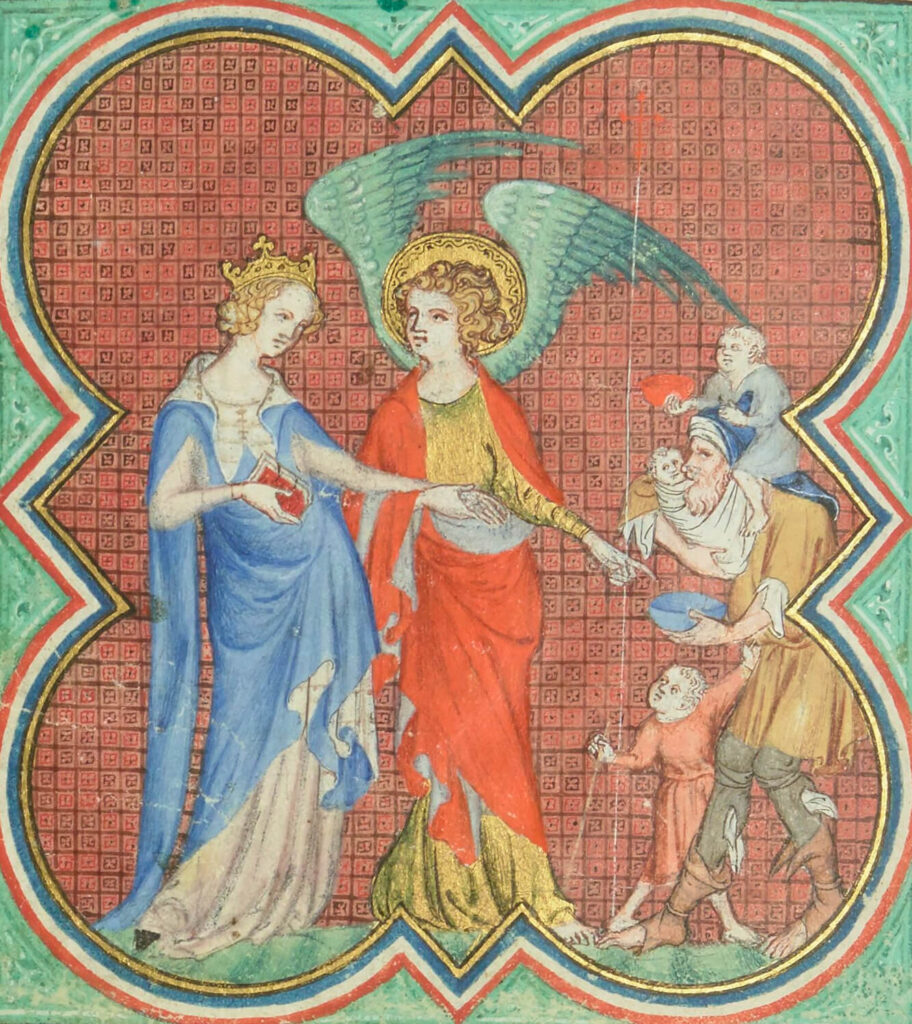
Females were not without their virtues. A virtuous woman was kind, gentle and compassionate. She was dedicated to her children and to managing the household. It was these virtues which ‘allowed’ women to act as Regent for her son if he were to become the heir while still a minor. It was assumed the queen regent would always act out of love by keeping at heart the interests of her late husband and her child. Charles VI wrote in an ordonnance giving his wife Isabeau of Bavaria the duty of governing his heirs, with “written reason and natural instinct, a mother has the most tender love and the most gentle heart towards her children, and is more diligent in protecting and nourishing them affectionately than any other person, even those next of kin, and for this [the mother] must be preferred to any other.”
Being a queen regent was one of few opportunities for the wife of a French king to gain power. Philip VI, who had gained the French throne by usurping his cousin’s daughters, trusted his wife, Joan of Burgundy, more than he did his courtiers. In 1338, faced with war against England, Philip VI designated his wife as regent during his lifetime with full powers in government, public finance, and justice if he were occupied elsewhere. According to Philip VI, his wife “was raised with him and must fall with him; who better to entrust with the dynastic heritage?”
queen consorts
There have been many great French queens – Eleanor of Aquitaine, Anne of Bretagne, Catherine de’ Medici, to name just a few. All were raised in noble families, educated, more than capable of running their kingdoms as well as they ran their households, while producing heirs at the same time. But they were constrained by the same laws and restrictions placed on almost all women throughout history. However, they found their niche, whether it be a ceremonial role in the royal court, a nurturing role as Queen mother, or a political role as regent. The French queens may not have been allowed to officially wear the crown, but they left their legacy in a myriad of other ways.
An earlier version of this article appeared in History is Now.